Byzantine Bronze Oil Lamp with a Chi-Rho Handle
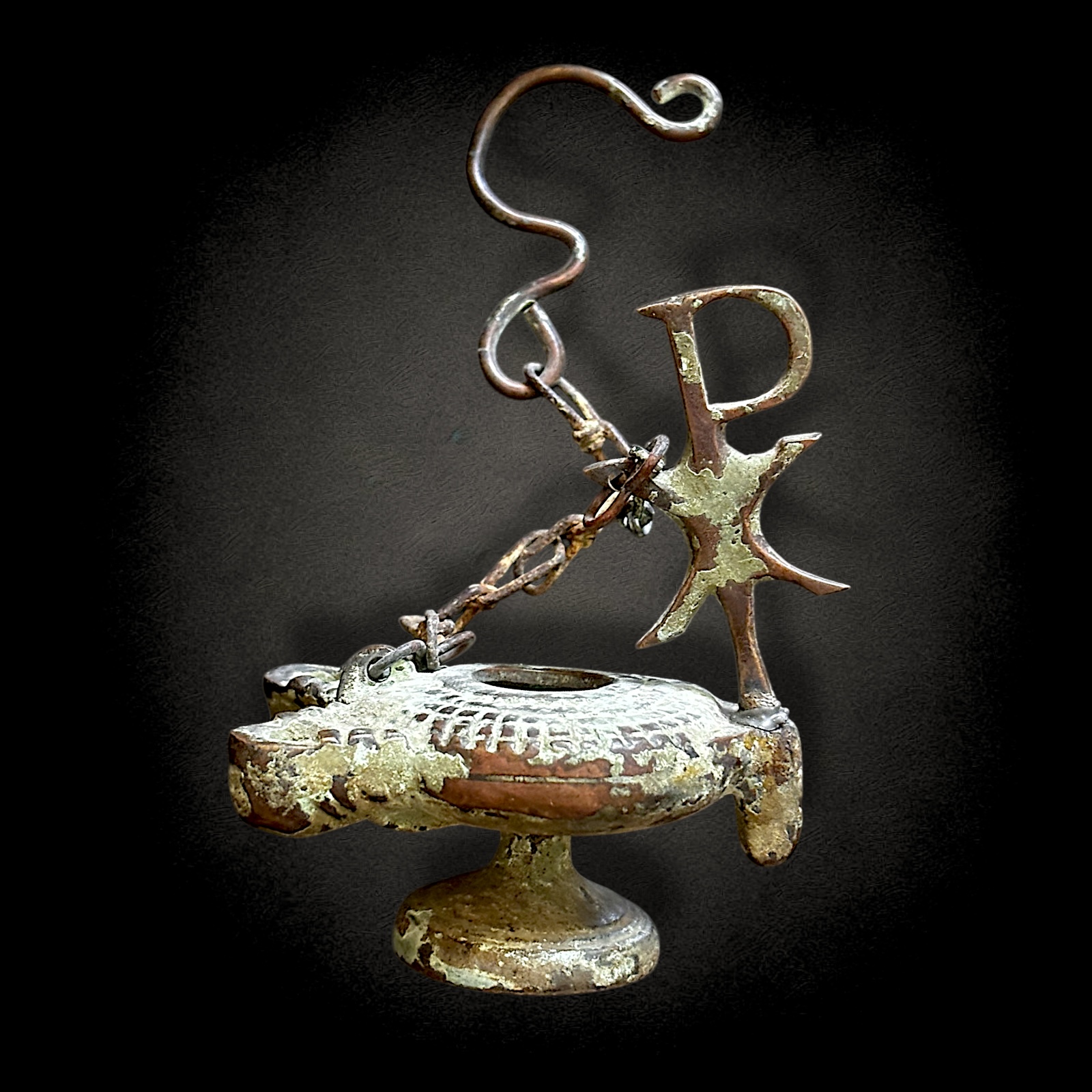
Byzantine Bronze Oil Lamp with a Chi-Rho Handle Byzantine Bronze Oil Lamp 300 – 600 AD. Byzantine bronze oil lamp; of circular footed form with braided rims and double nozzles, a Chi-Rho handle with attached chain (heavy wear). Handle was originally broken and has been reattached with some form of adessive. The Chi Rho (/ˈkaɪ ˈroʊ/; also known as chrismon or sigla) is one of the earliest forms of christogram, formed by superimposing the first two (capital) letters—chi and rho (ΧΡ)—of the Greek word ΧΡΙΣΤΟΣ (Christos) in such a way that the vertical stroke of the rho intersects the center of the chi. The Chi-Rho symbol was used by the Roman emperor Constantine I (r. 306–337) as part of a military standard (vexillum). Constantine’s standard was known as the Labarum. Early symbols similar to the Chi Rho were the Staurogram (Christliche Symbolik (Menzel) I 193 2.jpg) and the IX monogram (Christliche Symbolik (Menzel) I 193 4.jpg). In pre-Christian times, the Chi-Rho symbol was also to mark a particularly valuable or relevant passage in the margin of a page, abbreviating chrēston (good). Some coins of Ptolemy III Euergetes (r. 246–222 BC) were marked with a Chi-Rho. Although formed of Greek characters, the device (or its separate parts) are frequently found serving as an abbreviation in Latin text, with endings added appropriate to a Latin noun, thus XPo, signifying Christo, “to Christ”, the dative form of Christus. From a private Dutch collection. Enquire Now
Related Products