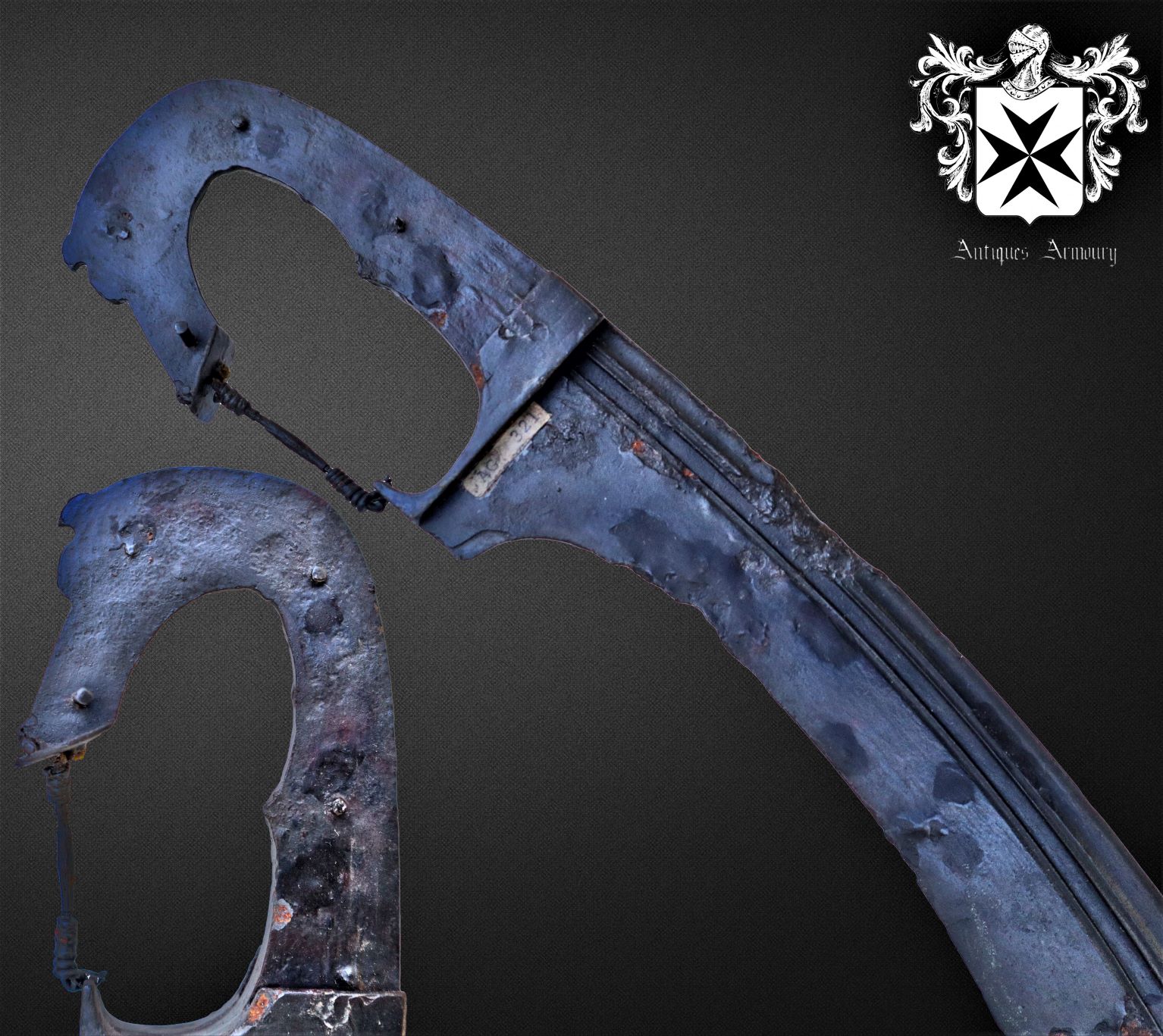
5th – 3rd century B.C. Iron Iberian Falcata Ex Axel Guttman Collection
5th – 3rd century B.C. Iron Iberian Falcata Ex Axel Guttman Collection One of the most relevant elements of the Iberian Culture is undoubtedly the falcata, a iron sword, with a unique appearance, curved-shaped, with a wide blade. Used by the Elite Mercenary Units, the Iberian Light Infantry armed with the falcata made by expert Iberian smiths. It was one of the highest quality blades of the Mediterranean. The lighter infantry wore just a short tunic with a wide leather belt and often no armour at all, but occasionally a bronze cap. They carried the falcata and a small buckler shield a caetra. The warriors were known to be superb fighters, they would move with acrobatic elegance. While considered light infantry due to their skill in battle Hannibal counted them as heavy infantry and used them to great effectiveness. They served with distinction in the Punic wars as well as the Greeks in the Peloponnesian War. 5th – 3rd century B.C. Iron cut-sword forged in one piece, the characteristically curved blade with a fuller and a stepped groove on both sides and double-edged for half its length. The pommel in shape of a horse head, riveted grip bolsters linked to the horse head pommel with iron wire. The hilt retaining five pegs from the attachment of the (lost) grip panels made of organic material. Also preserved are several scabbard mounts and large-headed decorative nails. Partially vesicular corrosion, otherwise fine patina. Axel Guttmann Collection (AG 321), acquired in Zurich in 1990. Cf. falcatas of this type from the Guttmann collection – Iberische Eisenwaffen – Hermann Historica, auction 44, 15 May 2003, lots 61 to 69. One of the finest and best conserved falcatas in the Axel Guttmann collection. It is slightly bent and has been professionally conserved by the curators of the collection. The conserved scabbard iron fittings are also included. Specifications: Length 55.5 cm Blade 45 cm Details on the Falcata from the Museo Aequelogico Nacional ORIGINS OF THE IBERIAN FALCATA. The falcata possibly originates from the Balkan coasts of the Adriatic. From there it spread to Italy, where it achieved great success, and to Greece, being called machaira or kopis. For the Greeks, this sword with its pronounced curved blade was a symbol of weapons of the Barbarians. In fact, it appears in Greek ceramics as an exotic element, attached to the Persians, Amazons, Thracians and other barbarian peoples, real and mythological. As Professor Fernando Quesada Sanz, a leading scholar of weaponry, has pointed out Iberian and of the falcata in particular, it was probably from the Italic world that it came to the Iberians, who substantially modified it (they reduced its curvature, shortened it and endowed with its characteristic double edge). Therefore, the Iberian falcata is not a mere copy or imitation of the machaira, but a new weapon, which was inspired by that one. The first falcatas found in the Iberian Peninsula date from the 5th century BC. c., and they lasted until the end of the 1st century BC. C. Although falcatas have been found in other regions, the vast majority come from Alta Andalucía and the Southeast. Consequently, it can be stated which is a characteristic weapon of the old contestans and bastetanos, and not the sword emblematic of all the Iberian peoples. The ancient Hispanics did not call it ‘falcata’, since it is a scholarly term from XIX century, used to designate a characteristic type of Iberian pre-Roman weapon shaped vaguely like that of a sickle (falx). MANUFACTURE, STRUCTURE AND DECORATION OF THE FALCATA. Thanks to the metallographic analysis we know that the falcatas were made with three sheets of iron welded together “a la calda”, that is, hot. The central lamina, wider than the lateral ones, was prolonged in a thin tongue that forms the metal soul of the handle, covered with scales of bone or wood, which in most cases do not have been preserved. In some higher quality specimens, the scales could be covered partially with metallic pieces that in turn were damascened. turn on itself to protect the hand from sharp blows, the handle adopted, most of the time, the shape of a horse’s head (as is the case of this falcata from Almedinilla) or of a bird raptor, and a rivet represented the eye of the animal, surely endowed with a protective character as well as decorative. As with other types of swords, the blade of the falcata presents deep grooves that lighten its weight, without diminishing its qualities of resistance and flexibility. In addition, these grooves gave the sword an obvious aesthetic effect. The falcatas, like other very special pieces, were decorated with damascene or ataujía. The decoration could be obtained by filling the incisions previously made with silver threads. They had made on the surface, hammering and then polishing the whole. you could also embed metal plates in the cut or carved surfaces, fixing them by means of the hammering of the partitions that trapped the incrustation. The type and arrangement of the decorative motifs on the falcatas is quite homogeneous. This, together with the concentration of decorated weapons in the Southeast and Alta Andalucía, makes assume that the workshops capable of manufacturing these pieces were scarce, or that they existed itinerant artisans who successively offered their work to the ruling elites of diverse towns in quite wide regions. THE IBERIAN WARRIOR AND WEAPONS. DEFENSE AND PRESTIGE. Iberian society was strongly hierarchical. Power was held by a warrior-style aristocracy, which controlled the production of goods and trade. Between the activities that characterized these ruling groups included hunting, banqueting in where wine was consumed and exploits were narrated, the celebration of solemn funerals in those who honoured the deceased with games or combats of a ritual nature, and war. This explains, to a large extent, the presence of armed human figures or combat scenes in the Iberian reliefs, sculptures and paintings, and the numerous weapons deposited in the grave goods. Now, this does not necessarily mean that Iberian society was especially bellicose or violent. For the Iberians, the possession of weapons was above all a sign of power and social status. The introduction by the Phoenicians of iron metallurgy during the 8th and 7th centuries BC. c., followed by its application in the manufacture of weapons, originated the appearance of true panoplies or equipment of offensive iron weapons during the 6th century. These panoplies were not not at all static since logically they varied over time according to the social transformations and the way of fighting. In this way, the warriors who held power in the early days of the Iberian Culture were characterized by a leadership with strong aristocratic and heroic connotations. These aristocrats used to wear a long, heavy spear, often accompanied by a lighter throwing one, and a sword short. They were protected with circular shields decorated with embossed bronze studs, helmets, metal armour discs and bronze greaves or shin guards. Later, from the IV century a. C. and until the Punic Wars, a more weaponry is imposed widespread, extended to a greater number of warriors, perhaps the result of the imposition of a less hierarchical social structure that materializes in the tombs, more numerous and less monumental than in the 6th and 5th centuries BC. C., and in a massive presence of weapons in grave goods. This more general panoply was made up of the falcata, the soliferreum or spear with an iron shaft and point, and a circular wooden shield with an umbo iron centre. The defensive armament (armour, helmets, greaves) was replaced probably for pieces of leather or other organic materials, less expensive than the weapons of the aristocratic panoply. From a social point of view, it is likely that these warriors formed a kind of military “clients”, individuals who would receive protection from their lord or leader and even land in exchange for military support, all guaranteed by firm ties of social dependency. From the end of the 3rd century B.C. C., when Iberia became a battlefield between Romans and Carthaginians, and until the absorption of the Iberian Culture in the Roman world, it tends towards a lighter offensive weaponry although the soliferreum and the falcata New types of weapons also appear, such as the type bronze helmets Montefortino, with a hemispherical shell topped with a normally perforated button or appendage to hold the plume of horsehair or feathers, and the large oval shields of large dimensions. Enquire Now